
An often ignored question in international relations is what happens to those who are born without a national identity. In the case of the Rohingya, an ethnic minority in Burma, they are excluded from citizenship and are stateless in every possible sense. Subjected to tremendous ethnic and religious discrimination in Myanmar, they were isolated from the majority of the Burmese population since colonial times and have suffered similar treatment under the current Burmese government. From January to March 2015 around 25,000 Rohingya people have crossed waters to seek asylum in South East Asia. The Rohingya refugee presents an unfamiliar situation to ASEAN, making it difficult for the rest of South East Asia to suddenly accept an influx of immigrants.

Entire ships carrying Rohingya refugees in the region are being sent back also as a result of anti-Muslim sentiment. As practitioners of Sunni Islam in a predominantly Buddhist nation, they are considered to be the world's largest persecuted minority group by the United Nations. The antagonisation of the Rohingya Muslims fits alongside global Islamaphobia, and ends up making the arrival of Rohingya seem as a threat when pre-existing stereotypes created by the Burmese are passed on to the rest of ASEAN. From a constructivist viewpoint, refugee crises often raise issues of national security but in reality Myanmar as a state actor intends to identify and create imaginary threats to unite its people against a common "other" to divert its general public from the corruption of its current authoritarian government.
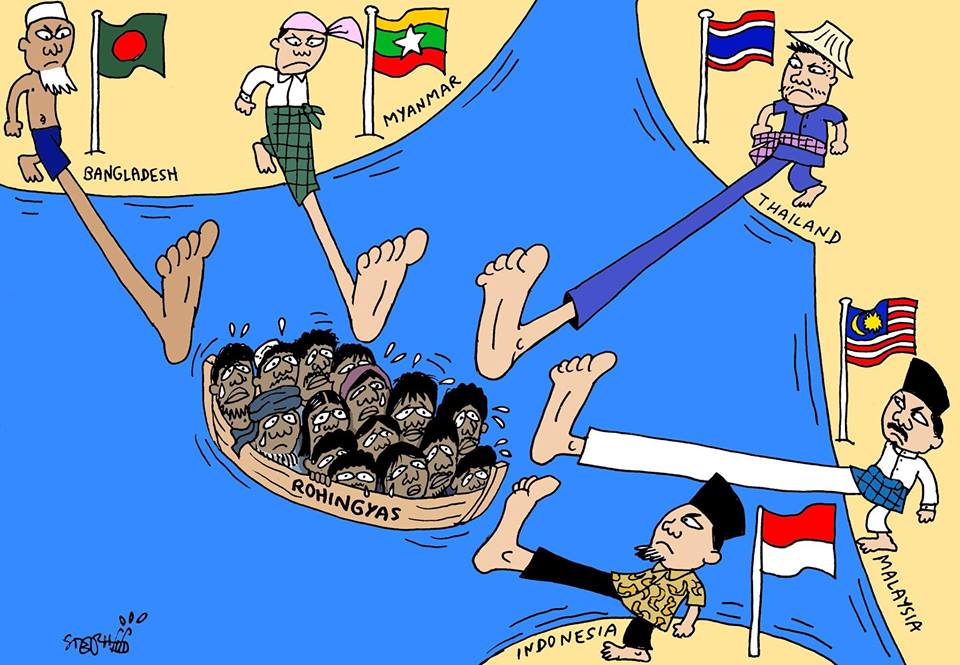
Indonesia and Malaysia:
Following international pressures, In May 2015, both Indonesia and Malaysia have made substantial efforts to take in more Rohingya boat migrants and have agreed to take in 7,000 Rohingya migrants who were stranded in the Andaman Sea. Talks between the foreign ministers of Thailand, Indonesia and Malaysia draw attention to a need to address the origin of discrimination as experienced by Rohingya. Although socially constructed, ASEAN states remain committed to find a more rational solution to the migration that may abide with human rights as Rohingyas have fled the country that doesn’t recognize them as a people. At the same time, ASEAN as a body that promotes democracy and security within the region, sees a moral obligation to assist a persecuted minority that has nowhere to go. By forcing its members to take action, it pressures Myanmar to reform their policy on the ethnic minority that has been unrecognised by the State since 1982.
Australia and the Philippines:
Australia has a history of aiding nations in need as the Australian governments have previously provided humanitarian assistance to the Rohingya living in the Northern Rakhine State in Myanmar. However, when questioned about whether Australia would grant entry to Rohingya migrants, Prime Minister Tony Abbot's response was "Nope, nope, nope." Following constructivist values of respect of state sovereignty and a principle of non-intervention in mind, Abbott blames the refugee crisis as being strictly a Burmese problem, allowing Australia to not view itself under any moral obligation to let in refugees. On the other hand, the Philippines has offered to allow the migrant boats landing rights in spite of its geographical location, carrying out its tradition of assisting boat migrants in a similar manner to migrants from Southern Vietnam in the 1970's.
Thailand:
Unease within the Arakan state has constantly seen Buddhist extremists brutally murdering Rohingya Muslims with the support of the Burmese military regime. The capital, Sittwe has retained this reputation of anti-Rohingya sentiment after 2012 riots drove 140'000 Rohingyans out of the city.
Australia has a history of aiding nations in need as the Australian governments have previously provided humanitarian assistance to the Rohingya living in the Northern Rakhine State in Myanmar. However, when questioned about whether Australia would grant entry to Rohingya migrants, Prime Minister Tony Abbot's response was "Nope, nope, nope." Following constructivist values of respect of state sovereignty and a principle of non-intervention in mind, Abbott blames the refugee crisis as being strictly a Burmese problem, allowing Australia to not view itself under any moral obligation to let in refugees. On the other hand, the Philippines has offered to allow the migrant boats landing rights in spite of its geographical location, carrying out its tradition of assisting boat migrants in a similar manner to migrants from Southern Vietnam in the 1970's.
For Rohingya who aim to arrive in Malaysia, they often need to make a first stop in Thailand. However Thailand has become a ground where Rohingya face indefinite detention upon entering the country. Treated as illegal immigrants, they are detained in immigration detention centres and in worst cases, they’re beaten and discarded through human trafficking to rubber plantation owners.
Unease within the Arakan state has constantly seen Buddhist extremists brutally murdering Rohingya Muslims with the support of the Burmese military regime. The capital, Sittwe has retained this reputation of anti-Rohingya sentiment after 2012 riots drove 140'000 Rohingyans out of the city.
Deprived of education and other basic human rights, communities are in fact encouraged by local authorities to use violence against the ethnic minority. The Rohingya have been constantly affected by systems of apartheid established by the Burmese in Rakhine. More recently, Buddhist monks joined anti-Rohingya rallies as seen in May 2015. As a means to counter international criticism of Myanmar's attitude towards the Rohingya minority, protesters marched against what they viewed as bullying on behalf of the international community. By claiming Rohingya Muslims as a threat to state religion and sovereignty, Burmese leaders have permitted the use of violence to allow the persistence of insurgency through religious nationalism and to fortify Buddhist solidarity that opposes a common enemy.

To Myanmar, the construction of means to normalise violence has incited the genocide and migration of the Rohingya people. By appropriating ethnic discrimination of a minority, Burma has effectively created a sense of ignorant nationalism that serves as a diversion from Burma's democratic issues. This in turn has sparked a need from ASEAN nations to step up and show that Myanmar needs to conform to universal humanitarian norms.

No comments:
Post a Comment