Terrorist attacks are the quickest method to create a state of political instability and raises national security concerns especially when it is not conclusive to who is responsible for causing them. As with the most recent bombing that took place on 17 August 2015 in Bangkok near Erawan Shrine injuring 125 and killing 20 people, police are still searching throughout the country for prime suspects, even mistaking Australian actor Sunny Burns for a terrorist. From a realist perspective, Thailand's failure to yet again prevent another bombing attack from occurring (with the last bombing in 2012), has disrupted its relations with other ASEAN nations. Reinforcing this image that Thailand as a nation is unable to prevent political turmoil is a factor that continuously affects South East Asia.

Artist rendition of the Yellow-shirted bomber
CCTV footage reveals a yellow-shirt wearing man dropping off a backpack near where the bombing occurred and is considered a main suspect to the disturbance. It is still unconfirmed to whether the identity of this man is known and whether he has been arrested, but cooperating Thai and Malaysian police have arrested two people in Malaysia of which one of them is suspected of being the yellow-shirt bomber. The Deputy Chief Chaijinda believes the main bomb suspect entered Thailand on a Chinese passport and has fled Thailand through Malaysia. He also claims that they have identified the yellow-shirted man but refuse to name him. This however could simply be a ploy to reassure ASEAN that there is progress of the investigation and leaves the possibility that the man is still on the run.
Internal terrorism:
The Thai government has not discarded the idea that like in other parts of the world, the attack could be organised by Islamist terrorists. Thailand has been fighting an insurgency in its southernmost Muslim-majority provinces, which has seen more than 6,400 people killed. Prime Minister Prayuth nonetheless dismisses this, stating that its more plausible to assume that it's an act of anti-government red-shirt protesters rather than terrorism from the South of Thailand. This reflects a classical realist attitude that the survival of the state should be the highest priority. Thailand under a military junta would much prefer to blame its problems onto a group that threats its legitimacy by implying the Red-Shirt movement's leader, Thaksin Shinawatra plotted the attack.
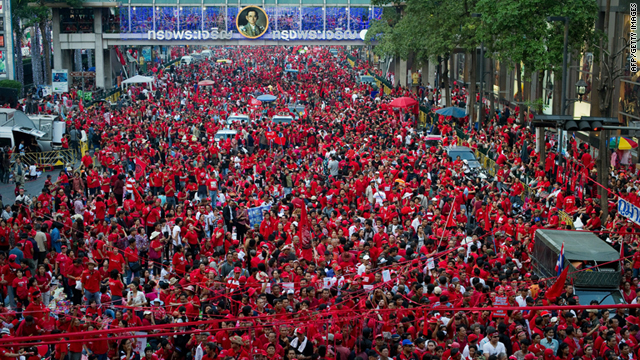
Red-shirt rally in 2011
The bombing could be the result of political division. In 2014, Thailand's middle-class protested to oust the populist and democratically-elected government of Yingluck Shinawatra, replacing it with a military junta. Erawan shrine also is an iconic gathering area for red-shirts. Although the bombing has struck a blow to Thai tourism and national security, the military-ruled government sees the situation as an opportunity to retain its role within Thai politics. If the current government is able to identify the culprit and rebuild Thailand quickly enough it will serve as a means of legitimisation for the junta and show that it's far more capable than previous democratically-elected governments.
China's Uyghur Muslims:
With several suspects appearing to be of the Muslim Uyghur minority in China, the attack could have been an act of revenge for Thailand's forced deportation of 109 Uyghur refugees to China in July 2015. The Erawan shrine happens to have many visitors from East Asia and China in particular, making it an obvious target for potential Uyghur terrorists.
Born in Xinjiang, Bilal Mohammed, who used a fake passport under the name of Adem Karadak to find work in the region, is the first of detained suspects in Thailand and claims he wasn't present in Thailand during the time of the bombing.

On 8 September, another suspect from Xinjiang, Yusufu Meerailee was arrested trying to flee across the Thai border into Cambodia and has admitted to possessing illegal explosives.

Structural realism as per Kenneth Waltz, involves balances of power on both state and international levels with Thailand deporting the Uyghur to support their strengthened relationship with China since the Junta came into power, even if this upsets Turkish Uyghur. At the same time, Thai police are exploring all internal factors that caused the bombing on the domestic level so the current Thai government has a reason to delay its stay in Thai politics.


No comments:
Post a Comment